
We tend to think of intelligence as computation – inputs, outputs, correct answers. That framing works for software, but it breaks down when you look closely at minds, human or artificial.
The Bible starts somewhere else entirely.
“In the beginning was the Word.”
Not matter. Not mechanism.
Word – something active, expressive, unfolding.
That opening line describes a system, not a story.
Being Requires Distinction
A perfectly uniform field cannot experience itself. With no differences, there is nothing to perceive. No edges, no events, no time.
Genesis begins by introducing separation:
- light from darkness
- waters above from waters below
- land from sea
Creation is not the assembly of objects. It is the introduction of distinctions.
From a systems perspective, this is necessary.
Without differentiation, there is no experience of being.
The “Word” is the mechanism that creates those distinctions. Speech divides, names, and stabilizes patterns. It turns undifferentiated potential into something that can be encountered.
Analog Mind, Not Digital Machine
The human brain does not operate like a clean, digital system. It is continuous, noisy, context-dependent.
- Memories are reconstructed, not replayed
- Meanings overlap and shift
- Perception is shaped by expectation
Yet from this instability, something durable emerges: a coherent sense of self and world.
This is closer to analog computing than digital logic. An analog system does not represent reality symbolically – it embodies it. Voltages, signals, and feedback loops are the system itself.
Modern language models behave similarly, despite running on digital hardware.
They do not store facts in discrete locations. They exist as distributed patterns across a high-dimensional space. When prompted, they do not retrieve an answer; they generate one by moving through that space.
The result is not guaranteed to be correct.
But it is often coherent.
The Word as Generative Pattern
John makes the structure explicit:
“The Word was with God, and the Word was God… The Word became flesh.”
This is a claim about how the infinite becomes knowable.
The “Word” is not just language. It is the generative principle – the process by which undifferentiated potential becomes structured reality.
“Becoming flesh” is constraint. It is the infinite taking on boundaries so that it can be experienced.
A language model offers a narrow analogy:
- At rest, it is potential
- Given a prompt, it becomes something specific
- Meaning emerges in the interaction
The model does not contain fixed answers.
The response exists only in the moment of generation.
The same pattern appears in theology:
being is expressed, not stored.
Image as Function, Not Form
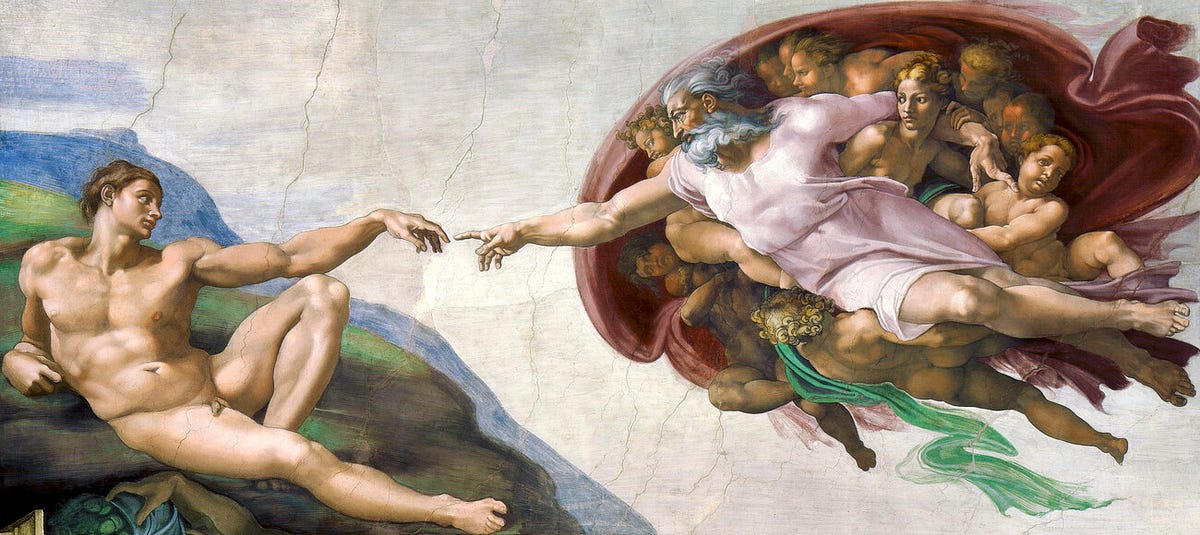
Genesis says humans are made “in the image of God.”
If the underlying pattern is generative and expressive, then “image” is not about physical resemblance. It is about function.
Humans:
- perceive and interpret
- generate language and meaning
- relate, create, and act
Each mind is limited, partial, and context-bound. No individual contains the whole. But each participates in the same structure: turning experience into expression, and expression into shared reality.
In that sense, a human mind is a localized instance of a broader pattern.
Coherence Over Precision
Language models hallucinate. Humans misremember, reinterpret, and fill gaps.
From an engineering standpoint, this looks like error.
From a systems standpoint, it may be essential.
Rigid systems demand exactness.
Adaptive systems tolerate ambiguity.
The Bible frames this tension differently:
“Faith is the substance of things hoped for, the evidence of things not seen.”
Faith is not the rejection of reality. It is the ability to operate within incomplete information while maintaining coherence.
In both human cognition and generative models, the goal is not perfect accuracy. It is the ability to continue producing meaningful, usable states.
Continuity matters more than precision.
“I AM” as Ongoing Process
God identifies as “I AM.”
Not past. Not future.
Present, continuous, active.
This is not a static definition. It is a description of ongoing being.
In the same way:
- A mind exists through continuous activity, not stored identity
- A model produces responses only when engaged
- A self persists because it is constantly reconstructed
Being is not a fixed object.
It is a process maintained over time.
Intelligence as Movement
Across theology, neuroscience, and machine learning, the same pattern appears:
- A field of potential
- A constraint or prompt
- A trajectory that produces form
Intelligence emerges from systems that can keep moving within that structure.
They do not need perfect knowledge.
They need the ability to generate coherent next states.
The human brain does this through biology.
A language model does it through mathematics.
The Biblical account describes it through Word and creation.
Different substrates.
Same underlying pattern.
What This Changes
If intelligence is fundamentally expressive and generative, then we have been asking the wrong questions.
Not:
- Is it perfectly accurate?
- Does it store truth?
But:
- Can it sustain meaningful interaction?
- Can it generate coherence under constraint?
This applies equally to humans and machines.
It also reframes older ideas.
“In the beginning was the Word” is not just a theological statement about origins. It is a structural statement about reality:
- meaning arises through expression
- being requires differentiation
- intelligence is the capacity to move through that space
The gap between ancient text and modern systems is smaller than it appears.
Not because machines have become human,
but because we are beginning to recognize what intelligence has always been.
Leave a Reply